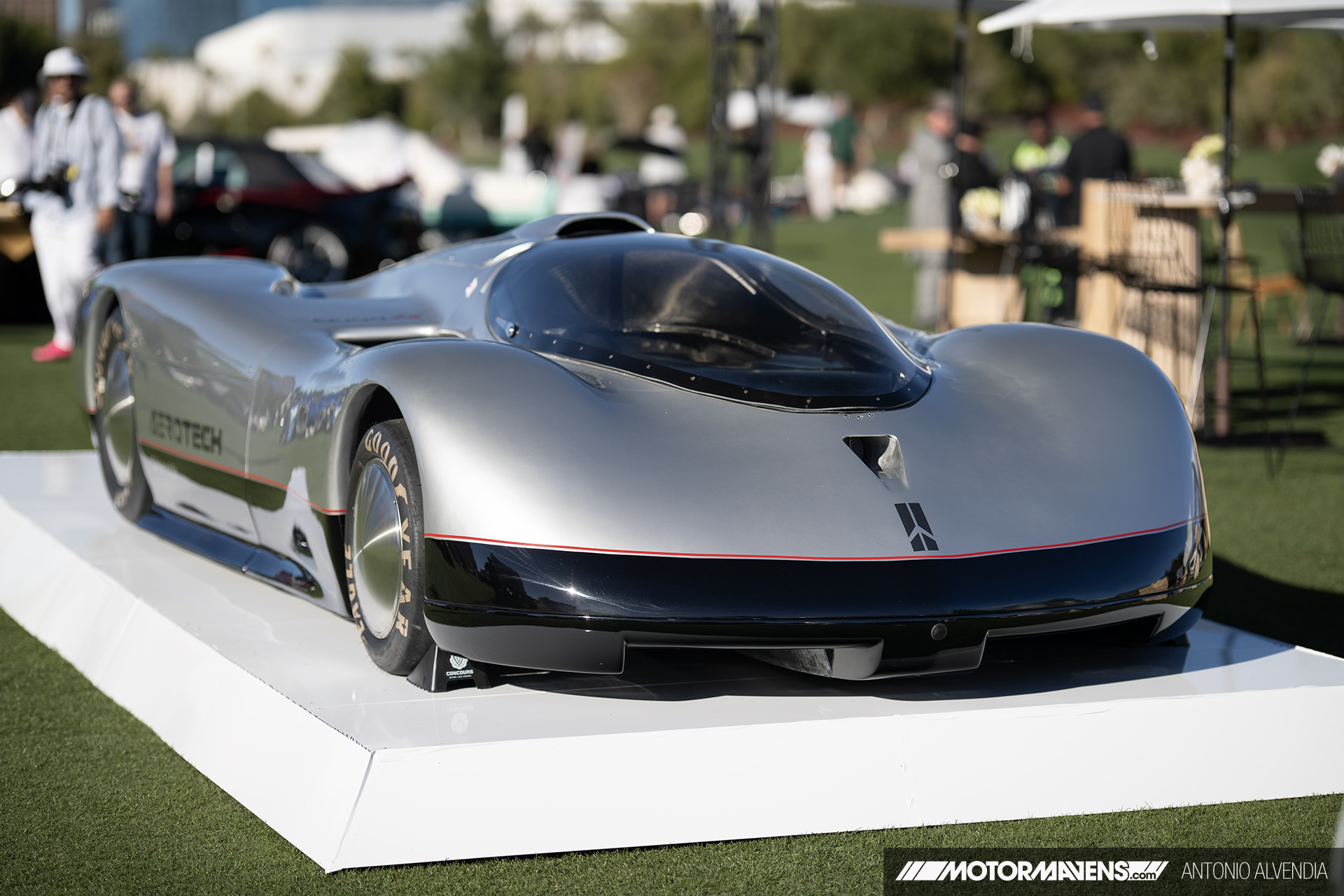
Oldsmobile Aerotech? What is it? Most people have never heard of it, and even fewer have seen one in person. I had no idea what it was until it appeared in front of me at the Las Vegas Concours at Wynn Las Vegas, sitting on the lawn front and center in front of the stage.
It was an insane retro futuristic long tail land speed record machine, 40 inches tall, built on an Indy car chassis, powered by a turbo 4 cylinder making close to 1000 horsepower. Even crazier, there were two of these things. One had a super cool long tail (BTW, do you think McLaren might have copied Oldsmobile’s homework when they created the Speedtail?), and one was a short tail, which looked more like a modern supercar. Apparently, for NASCAR and Indycar and Le Mans driver (and team owner) AJ Foyt drove one to nearly 280 mph on a Texas test track in 1987.
Randomly discovering these machines on the green in Las Vegas felt genuinely unreal… but hey, this is The Wynn we’re talking about. They have a reputation for surprising and delighting guests. Just in my limited time walking around at The Wynn, I’ve seen people like Justin Timberlake, Kevin Hart, Jimmy Fallon, Robin Thicke, David Coulthard, and even Lando Norris’s dad, Adam.
The Oldsmobile Aerotech: The American Land Speed Record Car Most Have Never Heard Of
Let’s start with the specs, because they need a moment to land.
The Oldsmobile Aerotech is 40.1 inches tall. That’s shorter than most kitchen counters. It sits on a modified March Engineering 85C CART chassis.
It shares the same architecture as the car that won the Indianapolis 500 in 1985.
The body is carbon fiber. The canopy over the cockpit is hinged at the front like a Top Gun fighter jet. Underneath all of that space age engineering, tucked into a machine built purely to hunt world speed records, is a four-cylinder engine. Yup, you read that right.
It’s an American record-breaker that isn’t a V8 or a V12. It’s a four-cylinder.
Oldsmobile’s Quad 4 engine was pretty revolutionary for an American production motor in the mid-1980s. It was a 2.3-liter inline four with dual overhead cams and four valves per cylinder. From the factory, it only made 150 horsepower, but the engineers behind it believed it had a much higher ceiling. They convinced GM management to let them prove it in the most dramatic way they could imagine, and built the Aerotech to find out exactly how fast that ceiling was. These guys were able to squeeze more than 8x the power output out of that thing!
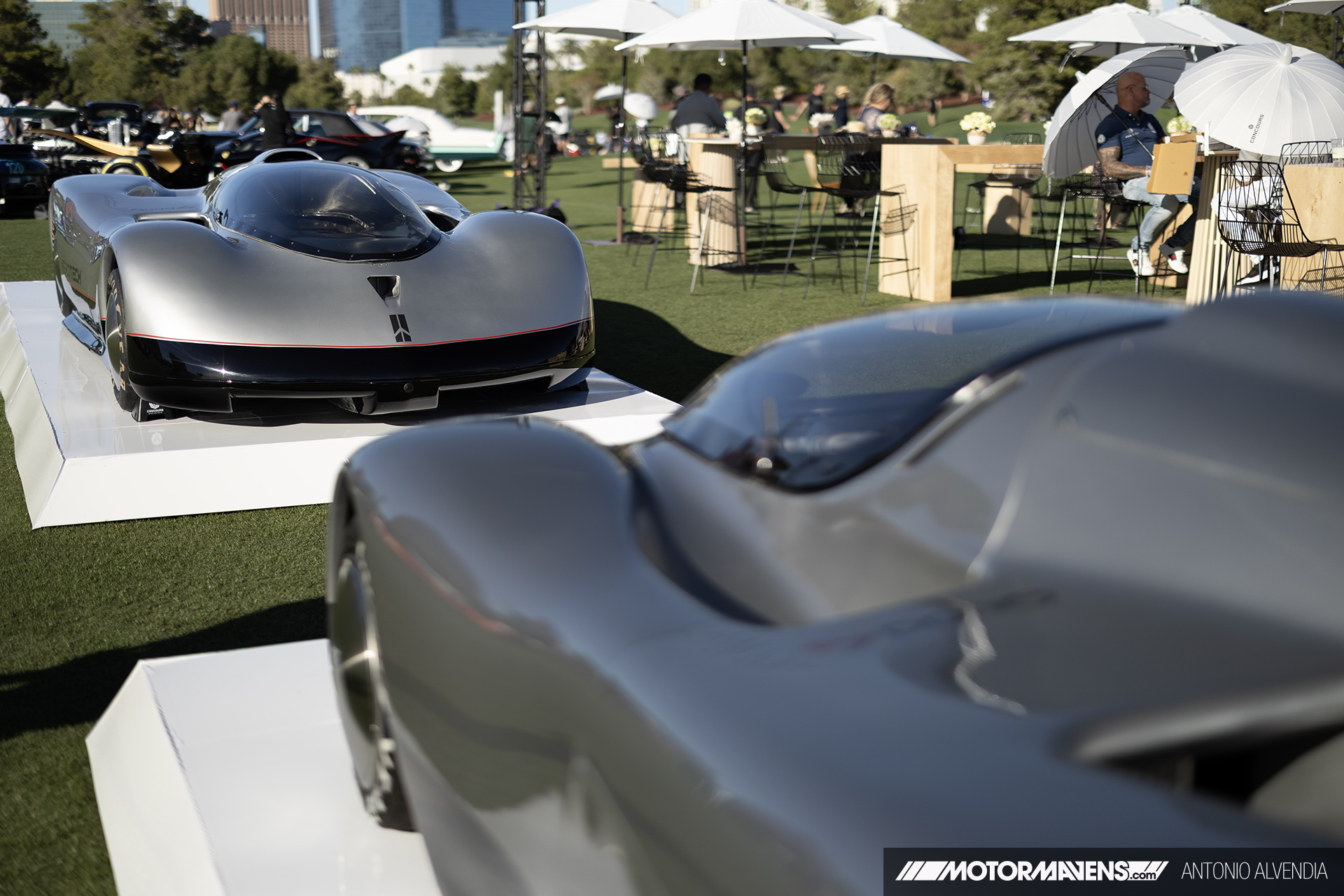
Oldsmobile Aerotech Long Tail, Short Tail, and 1200hp from a 4 Cylinder
Oldsmobile built two versions of the Aerotech for the 1987 record attempt: a short-tail car and a long-tail car. Each carried a different interpretation of the Quad 4, built under a single marketing mandate: retain the engine’s “production architecture.”
However, there is a massive distinction between “production architecture” and “production parts.”
A longtime friend of MotorMavens, Dean Case from Motivo Engineering and SAE SoCal, clarifies the reality of these engines: “The late great Jim Feuling gave a wonderful presentation to the SAE SoCal Section on their engine in the late 1980s,” Case notes. “‘Production architecture’ does NOT mean production parts. It was a pure racing engine that maintained the bore center spacing and valve angles, but it was not exactly built from the 150hp factory unit. It was powered by Oldsmobile $$$. While the bodywork design came from the GM studio, the heart of the beast was a different animal.”
The short-tail car’s engine was handled by Batten Heads of Detroit, who wrung an estimated 900 horsepower out of it with a massive single turbo.
For the long-tail car, Oldsmobile turned to Feuling Engineering of California. Jim Feuling was a polymath of speed—an inventor, author, pilot, and master of fluid dynamics who founded Feuling R&D/Advanced Technologies in 1974. Feuling went even further, utilizing twin turbos to push the power to a staggering 1,270 horsepower from just 121 cubic inches.
According to the Museum of American Speed, Feuling received the “Outstanding Technical Achievement Award” for this “clean sheet” design. It developed the highest specific power output of any automotive engine in history at the time.
267 MPH in the Year of RoboCop
On August 27, 1987—the same year RoboCop hit theaters and The Cosby Show ruled the airwaves—four-time Indy 500 winner A.J. Foyt took both cars to a 7.7-mile test track near Fort Stockton, Texas.
With FIA officials watching, the short-tail car set a new world closed-course speed record at 257.123 mph, breaking a mark Mercedes-Benz had held since 1979. Then, Foyt climbed into the Feuling-powered long-tail (LT) car. He averaged 267.399 mph over the flying mile, with one run clocking him at 278.357 mph on the straight. Foyt was reportedly entering the banking at over 250 mph, letting the car slide until it found its line.
An Underrated Legacy
Jim Feuling, a member of the 300 MPH chapter of the Bonneville 200 MPH Club, passed away in 2002 after a battle with pancreatic cancer, but his work on the Aerotech remains a pinnacle of American engineering.
This is one of the most underrated chapters in American motorsport history. Even after writing about motorsports for 20 years, it’s a story that still feels like a well-kept secret. It was a moment when American engineers took a humble four-cylinder architecture and, with enough “Oldsmobile $$$” and the genius of men like Jim Feuling, outran the rest of the world. (Even though I’ve been writing about motorsports for 20 years, I didn’t even know about this car until Alex and I researched it for this story.)
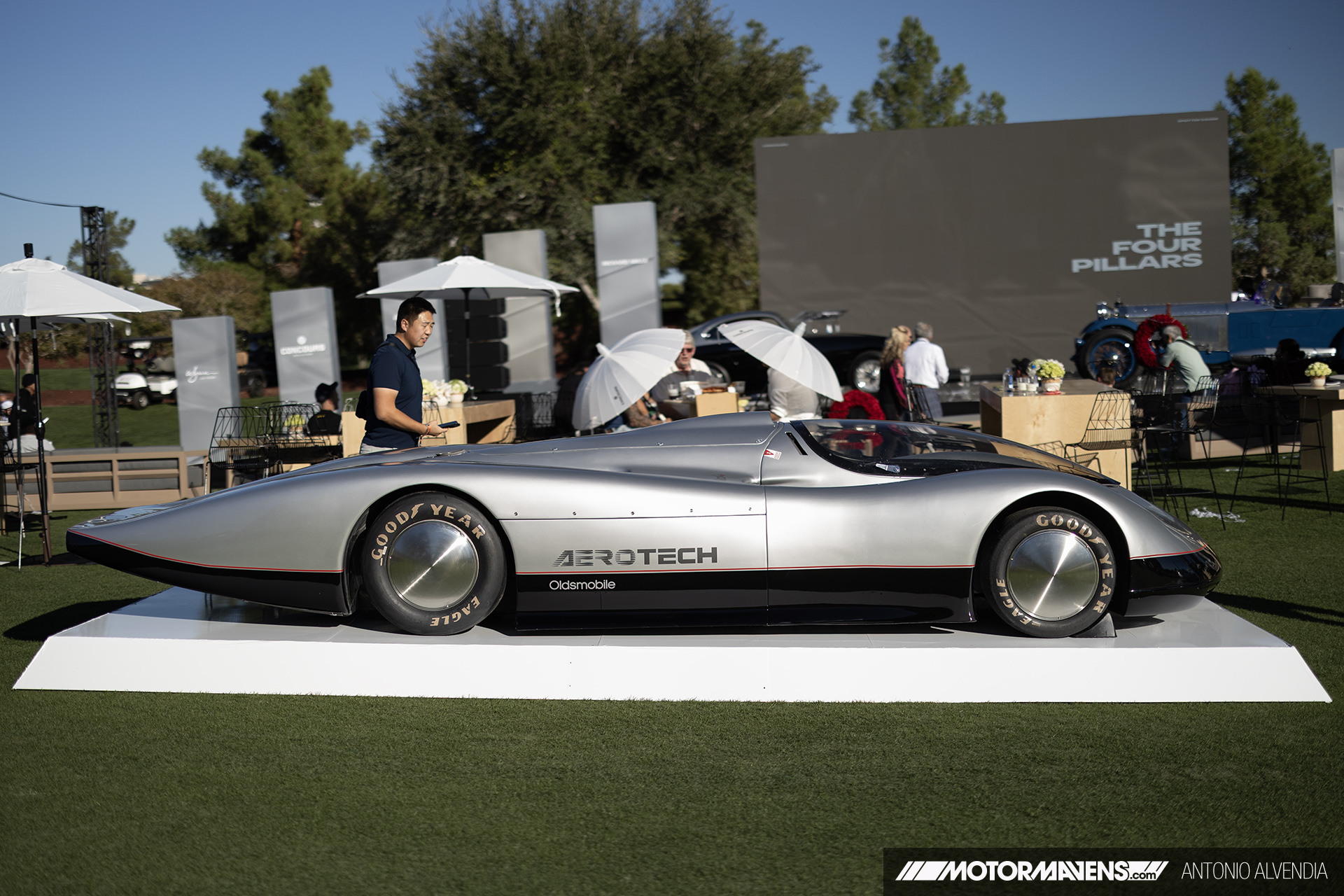
Seeing the Oldsmobile Aerotech Long Tail in Person is Jaw-Dropping
Photos don’t prepare you for how low and aggressive the Aerotech looks in real life. Standing next to it at the Las Vegas Concours, with the immaculate green golf course grass framing the whole scene, the car felt genuinely otherworldly. It was like something from a parallel timeline where Oldsmobile was still racing at Le Mans instead of quietly fading from the market.
The details that get you up close are the ones you don’t expect. The way the bodywork flows around the fenders. The underbody tunnels designed to generate downforce at speeds most race cars never see. That fighter jet canopy sitting over a cockpit where AJ Foyt once sat with 40 pounds of boost on tap and nearly 300 mph on the horizon.
Also, I wonder if those polished aluminum discs over the wheels are actual Moon Discs from Mooneyes?! If so, that would be cool as hell.
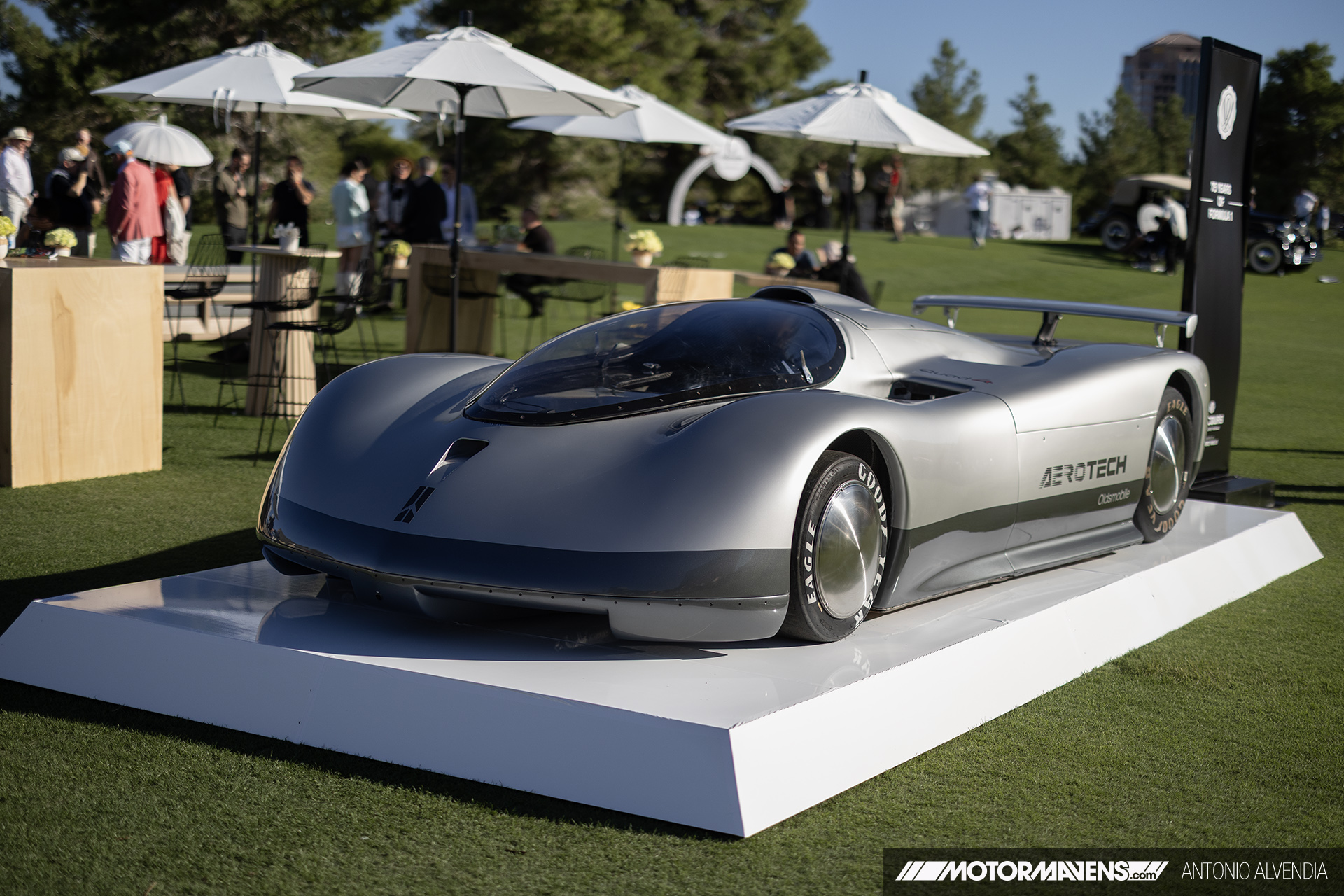
The white pedestal it was displayed on at the concours felt exactly right. This car belongs in the same sentence as the most significant American performance machines ever built. Seeing it treated with that level of reverence, in that setting, in front of an audience that genuinely understood what they were looking at — that’s a curatorial decision that says everything about what the Las Vegas Concours is trying to be.
They didn’t just bring a cool car. They brought a story most of the automotive world forgot to tell.
You Should Be at the Next Las Vegas Concours
The Las Vegas Concours d’Elegance at Wynn Las Vegas is the kind of event that earns its reputation one car at a time. The setting is stunning, the curation is serious, and the caliber of what shows up on that lawn keeps raising the bar.
My advice: go to the next one. Intentionally dress well, like you belong there. At an event like this, you never know who’s standing next to you admiring the same car. The conversations that happen at The Wynn, between people who share a genuine passion for automotive history, are the kind you carry with you long after the event is over.
The Aerotech reminded me that the best car stories aren’t always the most famous ones. Sometimes they’re parked on a lawn in Las Vegas, waiting for someone to stop, look closer, and realize what they’re actually standing in front of.
Don’t miss it.
Words and Research: Antonio Alvendia and Alex Pordes
Photos: Antonio Alvendia
Instagram: @AntonioSureshot • @MOTORMAVENS
www.antoniosureshot.com
Info Sources:
Follow MotorMavens on Instagram at @MotorMavens for daily content, build updates, and real enthusiast culture. Subscribe to the MotorMavens YouTube channel for video features, shop tours, and everything happening with the builds you’ve been following. The community lives there. Come be part of it.